
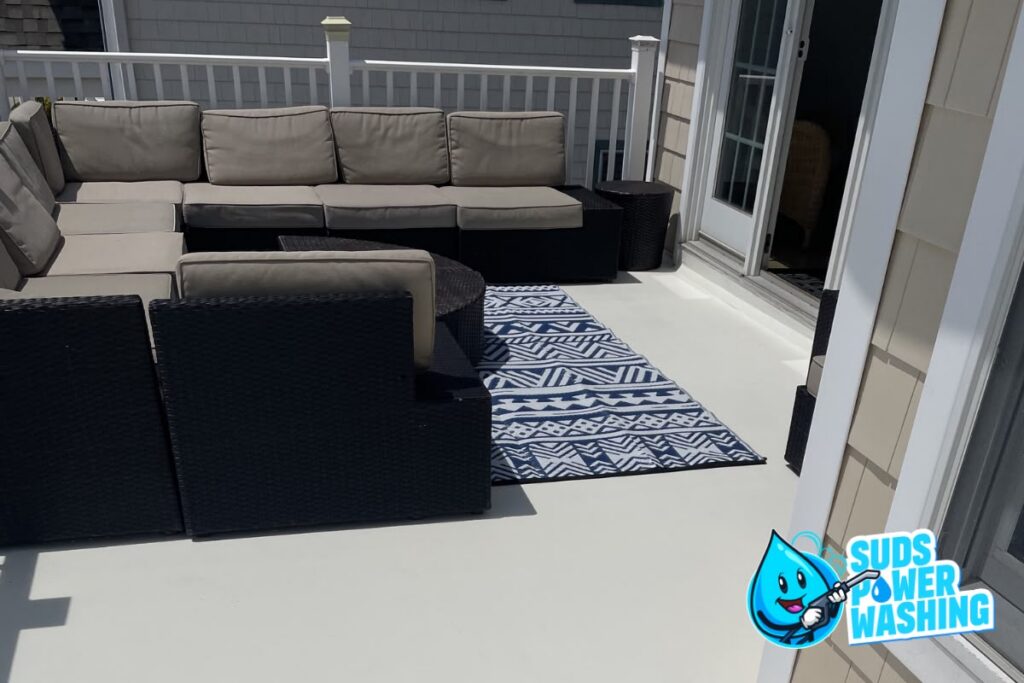
SUDs Power Washing provides professional composite decking cleaning services in Pennsylvania for residential properties and the most important thing most composite deck owners do not know is that standard pressure washing at residential contractor PSI levels can permanently scratch the surface of composite boards, degrade the UV-protective cap layer, and void the manufacturer warranty on products from brands including Trex, TimberTech, and Azek. Composite decking is not wood, and cleaning it safely requires understanding what the material is, what it responds to, and what it rejects.
The deck looks great from a distance but there is a green tinge developing along the shaded end, or the boards are looking chalky and dull compared to when they were installed five years ago. You are thinking about renting a pressure washer or calling a power washing company. This article explains why the approach matters more than most people realise and why the difference between the right and wrong cleaning method on composite decking is not just about the result you see on Saturday, but about the 25-year warranty you thought you had for the following two decades.
In this article:
- What is composite decking and how is it different from wood decking in terms of cleaning and maintenance?
- Can you pressure wash composite decking and what happens when you use the wrong pressure or technique?
- What does professional composite decking cleaning from SUDs Power Washing involve and how do you book?
What is composite decking and how is it different from wood decking in terms of cleaning and maintenance?
Composite decking is a manufactured outdoor decking material made from a blend of wood fibre and recycled plastic, typically encased in a protective polymer cap layer that gives the board its colour, texture, and resistance to moisture, UV fading, and surface staining. Unlike wood decking, composite boards do not need sealing, staining, or painting to maintain their appearance but they do require specific cleaning methods that protect the cap layer, because high-pressure washing or abrasive cleaning can permanently scratch or degrade the surface and void the manufacturer warranty.
What composite decking is made of and why the cap layer matters
The core of a composite deck board is typically a blend of wood flour (finely ground wood fibre) and polyethylene or PVC plastic. This core gives the board structural rigidity and dimensional stability. Around the core, manufacturers like Trex, TimberTech, and Azek apply a cap layer a solid polymer shell that encases the board on three or four sides. The cap layer is what you see and touch. It is what gives composite decking its realistic wood grain appearance, its colour, its resistance to moisture infiltration, and its resistance to surface staining. It is also what is damaged by high-pressure cleaning. Understanding that the cap layer is a distinct component from the board core is the single most important piece of context for understanding why composite decking needs different cleaning than wood.
How composite decking ages differently from wood and what cleaning it actually needs
Wood decking requires annual or biennial sealing, staining, or painting to prevent moisture infiltration and UV graying. Composite decking does not require any of those interventions; the cap layer handles moisture and UV resistance for the rated lifespan of the board, typically 25 to 30 years from major manufacturers. What composite decking does accumulate is surface-level contamination: algae and mould growth in shaded or damp areas, pollen and tannin staining from adjacent trees, chalky mineral residue from hard water sprinklers, and the organic film that develops on any outdoor horizontal surface over time. None of these contamination types require high pressure to remove. They require the right cleaning solution and appropriate low-pressure application which is exactly what professional soft washing delivers and what a standard power washing service typically does not.
What happens when composite decking is not cleaned for multiple seasons
Algae and mould that develop on a composite deck do not penetrate the cap layer the way they penetrate untreated wood. But they do create a slip hazard on the surface, and if left for multiple seasons, they can embed in the texture of the cap layer and become significantly harder to remove without more aggressive cleaning. In Pennsylvania, where spring pollen, summer humidity, and autumn leaf debris all create ideal conditions for algae growth on shaded deck surfaces, a once or twice annual professional composite deck cleaning keeps the deck in the condition the manufacturer designed it to maintain.
What are the most popular composite decking brands used in Pennsylvania?
Trex is the most widely installed composite decking product in Pennsylvania residential homes, followed by TimberTech (manufactured by AZEK Building Products) and Fiberon. All three use polymer cap systems and have specific manufacturer cleaning guidelines that prohibit high-pressure washing above 1,500 PSI on capped composite boards. SUDs Power Washing is familiar with the specific cleaning requirements of all major composite decking products and cleans within those manufacturer guidelines on every appointment. The Trex composite decking care guide is the primary manufacturer reference for cleaning guidelines and is worth reviewing before any cleaning method is used on Trex boards.
Can you pressure wash composite decking and what happens when you use the wrong pressure or technique?
Composite decking can be cleaned with a pressure washer, but most major composite decking manufacturers including Trex, TimberTech, and Azek specify a maximum pressure of 1,500 PSI or less, fan tip spray at a minimum 12-inch distance from the surface, and water flow direction that follows the board grain rather than cutting across it. Exceeding these limits can permanently scratch the polymer cap layer, create visible streaking, degrade the board surface texture, and in many cases void the manufacturer warranty which most standard residential power washing services operate well above.
What high pressure does to the composite cap layer and why the damage is permanent
Standard residential pressure washing services often operate at 2,000 to 3,000 PSI for general surface cleaning. On concrete, brick, and wood siding, this pressure range is appropriate and necessary. On composite decking, that same pressure directed at the polymer cap layer abrades the surface creating microscopic scratches that become visible as streaking or a dulled surface appearance, permanently altering the board texture, and breaching the moisture protection of the cap system. The damage is not always immediately obvious after cleaning but becomes apparent over the following season as the affected area weathers differently from the undamaged sections of the deck. Once the cap layer is compromised, the board cannot be restored to its original surface quality by cleaning. The damage is the cleaning.
The warranty implication: why the cleaning method matters as much as the product
Trex, TimberTech, and Azek all publish cleaning guidelines as part of their product warranty terms. Cleaning methods that exceed the specified PSI limit, use narrow spray tips, or apply pressure at the wrong angle or distance can constitute improper maintenance under warranty terms and provide grounds for warranty denial on surface defect claims. A homeowner who hires a general pressure washing service that cleans the composite deck at 2,500 PSI may unknowingly forfeit their warranty coverage on a product designed to last 25 to 30 years. This is not a risk most homeowners know to ask about before booking and it is not a risk most general power washing services disclose before starting.
What safe composite deck cleaning looks like: soft washing as the professional approach
Soft washing uses lower water pressure typically under 500 PSI in combination with biodegradable cleaning solutions specifically formulated to treat algae, mould, tannin staining, and organic film at the surface level without relying on pressure as the primary cleaning mechanism. The solution does the work; the water rinses. This approach is within every major composite decking manufacturer’s approved cleaning guidelines, produces equivalent or superior results to pressure washing on organic contamination, and does not risk cap layer damage or warranty void. It is the professional standard for composite deck cleaning and the approach SUDs Power Washing applies on every composite deck appointment in Pennsylvania.
Can you paint composite decking?
Technically yes, but it is almost never recommended and often voids the manufacturer warranty. The polymer cap layer on composite decking is designed to be non-porous, which means paint adhesion is poor and paint applied to composite decking typically peels within one to two seasons because the cap surface cannot hold a paint film the way bare wood can. Composite decking that has faded significantly or is discoloured is almost always better addressed through professional cleaning which removes the surface contamination that often accounts for the perceived fading or through board replacement rather than painting. Most manufacturers consider painting a modification that voids the warranty. If you are looking at your composite deck and thinking about paint, a professional cleaning assessment first is almost always the right answer.
What does professional composite decking cleaning from SUDs Power Washing involve and how do you book?
SUDs Power Washing composite decking cleaning in Pennsylvania uses low-pressure soft washing technique typically under 500 PSI with biodegradable cleaning solutions formulated for composite deck surfaces, applied to remove algae, mould, tannin staining, and organic surface film without exceeding the manufacturer PSI limits for Trex, TimberTech, Azek, and Fiberon products. The result is a composite deck that is clean to the original board colour and texture without scratching, streaking, or cap layer damage and without voiding the manufacturer warranty.
Here is what the appointment looks like in practice. When the crew arrives, the composite decking brand is noted where identifiable, the contamination type is assessed algae, mould, tannin staining, or general organic film each respond differently and the appropriate biodegradable cleaning solution is selected for the specific deck condition. The solution is applied to the full deck surface and allowed to dwell. The dwell period is when the solution works on the organic contamination at the surface level. After dwell, the deck is rinsed at low pressure following the direction of the board grain, which is how every major manufacturer specifies the rinse step. The result is a clean deck without streaks, without surface damage, and without residue.
Before the crew arrives, clear furniture, planters, and moveable items from the deck surface. A standard residential composite deck takes 60 to 90 minutes from setup to completion. Scheduling typically allows for one to two week advance booking in normal season conditions.
Pool deck cleaning for composite or capped composite pool decks follows the same soft washing approach the surface material requires the same PSI discipline regardless of the deck location. Patio cleaning and walkway cleaning are often added to the same appointment for homeowners doing a complete outdoor surface refresh.
How often should composite decking be professionally cleaned in Pennsylvania?
Once a year is sufficient for most residential composite decks with normal organic contamination. Twice a year spring and autumn is recommended for decks in heavily shaded areas, decks adjacent to trees that drop high-tannin leaves or significant pollen, or decks with a history of algae or moss growth. Pennsylvania’s spring and summer conditions create ideal algae growth conditions on any shaded outdoor surface. SUDs Power Washing offers recurring composite deck cleaning schedules for homeowners who want the deck maintained consistently without managing the booking each season.
Your Composite Deck Was Designed to Last 30 Years Professional Cleaning Is What Keeps It Looking That Way
You spent real money on composite decking because you did not want to sand and stain every summer. The right cleaning approach protects that investment for the life of the warranty. The wrong one a standard power washing service with no PSI awareness can write off a 25-year product in an afternoon.
Book a composite deck cleaning with SUDs Power Washing and get a soft washing appointment that works within your manufacturer guidelines, removes the contamination that is making the deck look older than it is, and keeps the warranty intact.