
You got a quote. It said a number. Maybe it said “house wash” or “driveway cleaning.” And that was pretty much it.
No mention of what actually happens when the crew shows up. No explanation of how they’ll handle the algae growing up the north side of your siding versus the oil stain baked into your concrete. Just a number, a date, and the expectation that you figure out the rest on your own.
That gap between what gets quoted and what actually happens is where most bad power washing experiences start. Not because the company was dishonest, necessarily. But because nobody explained the process, and when nobody explains the process, nobody is held to one.
SUDs Power Washing operates across Pennsylvania doing residential power washing and commercial power washing jobs where the scope is explained before the equipment comes off the truck. This post is that explanation. What a professional power washing services covers, surface by surface, and how to tell whether the quote sitting on your counter actually reflects that.
In this article:
What Does a Professional Power Washing Service Actually Cover?
Most homeowners picture power washing as a single action: high-pressure water, dirty surface, clean surface. In practice it is four or five distinct steps, and the ones that happen before and after the main wash are usually what determine whether the job looks good six months from now or needs to be redone.
What Happens Before the Water Even Turns On?
A professional power washing service starts with a surface assessment, identifying the material type, checking for existing damage, and choosing the correct pressure and temperature settings before anything else happens. Skipping this step is the most common reason homeowners end up with etched concrete or raised wood grain after a job that was supposed to make things look better.
Here is what that assessment actually looks for. Older concrete develops micro-fractures that high-pressure water can widen. Painted wood surfaces have a different tolerance than raw wood. Composite decking reacts differently than pressure-treated lumber. Vinyl siding with existing cracks will take water behind the wall if the nozzle is angled wrong. None of this requires a long inspection. An experienced crew spots most of it in the first few minutes walking the property. But a crew that goes straight from the truck to the equipment without looking first has already skipped the part of the job that protects your property.
The power washing services process at SUDs starts here, before the water pressure is even set.
What Does the Actual Wash Process Involve?
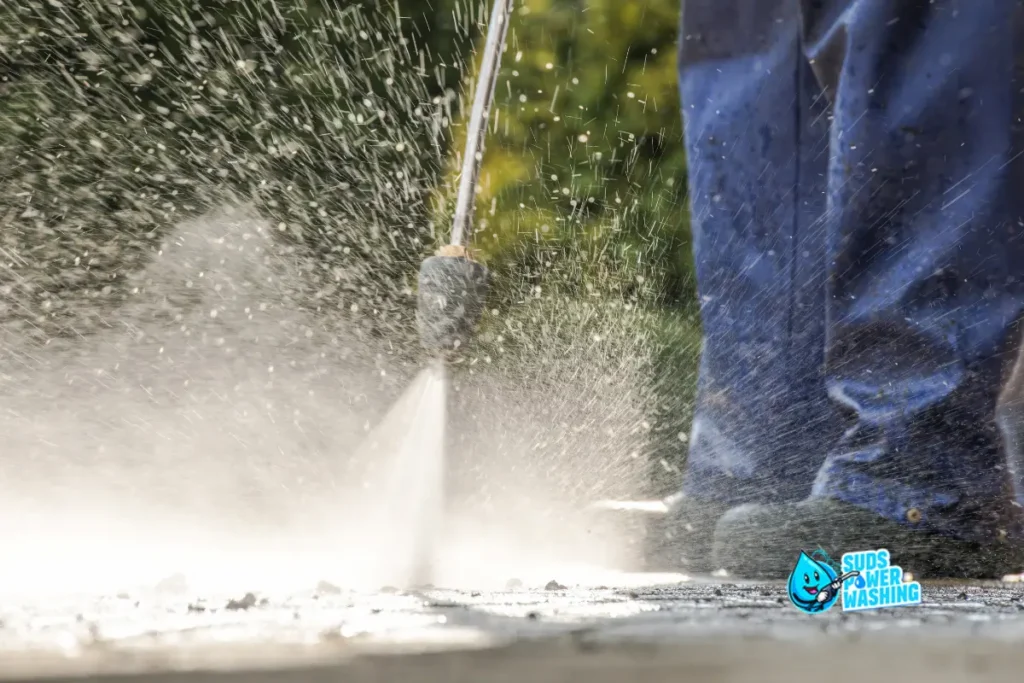
The wash process for a professional power washing service includes a pre-rinse to loosen surface buildup, the primary wash pass at the pressure and temperature appropriate for the material, cleaning solution application where needed, and a post-rinse to clear any remaining residue. For organic growth like mold, algae, or mildew, soft washing is often the correct method rather than high-pressure washing. Soft washing uses lower pressure with a cleaning solution that dwells on the surface long enough to kill the growth at the root rather than just blast the visible layer off the top.
The reason this distinction matters: high pressure on a surface with active mold growth removes what you can see. The mold comes back in a few weeks because the root system in the material was never addressed. Soft washing kills it. The surface stays clean longer, and you are not booking the same job again before summer ends.
Pressure settings, nozzle choice, water temperature, and whether a cleaning solution is needed and which one are all decisions that get made during the assessment. A professional service documents those decisions. A rushed one applies one setting to everything and moves on.
What Gets Checked After the Job Is Done?
A professional power washing service ends with a post-job walkthrough, checking that every treated surface is clean, that no surrounding areas were affected during the wash, and that runoff was directed away from plants, drains, and neighboring surfaces. This is the step that most crews skip because the surface looks clean and the next job is already on the schedule.
What the walkthrough catches: cleaning solution residue that settled on a surface outside the work area. Water that pooled at a low point near a foundation. A section of fence that got missed because the angle was awkward. None of these are catastrophic on their own. But finding them before the truck leaves is significantly easier than following up on a complaint three days later.
Part of that final check is also looking at adjacent systems. If runoff from a roof wash pushed debris into a gutter, that is worth noting. SUDs includes gutter cleaning as a separate service for exactly this reason. A house wash and a gutter clean done together means nothing gets moved from one problem area into another.
What Does Each Surface Require and What Should Happen to It?
The biggest gap in most power washing quotes is that they treat the whole property as one job. A driveway and a wood deck require different pressure settings, different nozzle types, and in some cases completely different methods. Here is what each surface actually needs.
Driveways and Concrete
Concrete driveways need high pressure to remove oil stains, tire marks, and embedded grime but the pressure has to be calibrated to avoid pitting or surface etching, particularly on older or decorative concrete. Driveway and concrete cleaning at SUDs includes degreaser pre-treatment for oil stains before the main wash pass. Without pre-treatment, high pressure alone moves oil around the surface more than it removes it.
One honest note on oil stains: if a stain has been sitting on concrete for several years and has penetrated past the surface layer, full removal is not always possible. A professional service will tell you that upfront. What power washing reliably does is remove the surface-level buildup, the tire marks, the biological growth, and the general grime that makes a concrete driveway look permanently gray. The difference in result between a professionally cleaned driveway and a DIY attempt with a rented machine is mostly about pre-treatment and dwell time, not the machine itself.
Decks and Wood Surfaces
Wood decks need lower pressure and a wider spray angle than concrete to avoid raising the wood grain or splintering the surface along the board edges. Deck cleaning is also one of the most time-sensitive power washing jobs on the calendar. A deck that gets cleaned before staining or sealing holds the finish significantly longer. A deck that gets stained over a surface with mildew, tannin bleed, or old finish residue will start peeling within one season, sometimes sooner.
If you are planning to stain or reseal your deck this year, the cleaning has to come first and it has to be thorough. The existing post on cleaning your deck before staining covers what that preparation looks like in detail, and it is worth reading before you schedule either service.
Siding, Fences, and Roofs
Vinyl siding, wood siding, fences, and roofs each require different pressure levels, different nozzle configurations, and in the case of roofs, a soft wash approach rather than high-pressure washing.
Vinyl siding cleaning responds well to moderate pressure with a cleaning solution for the algae and oxidation that builds up on north-facing walls. Too much pressure forces water behind laps or into seams and creates moisture problems inside the wall cavity. Fence cleaning depends heavily on the fence material. Vinyl fences handle more pressure than wood. Older wood fences with any weathering or cracking need the same care as a wood deck.
Roofs are where the most damage happens when the wrong method is used. High pressure on asphalt shingles strips granules and accelerates wear. Roof cleaning is a soft wash job. The cleaning solution handles the black streaking from algae, the moss, and the lichen growth. The pressure is low. The result lasts longer than a high-pressure pass would anyway, because the biology is actually dead rather than temporarily dislodged.
How Do You Know If the Service You Were Quoted Is Thorough or Rushed?
What Should a Legitimate Power Washing Quote Actually Tell You?
A legitimate power washing quote specifies which surfaces are being cleaned, what cleaning method will be used for each surface, an estimated time on site, and whether post-job cleanup of surrounding areas is included. A quote that gives a total price with no scope description is a starting point for a conversation, not an agreement.
The 5 common power washing mistakes post on the SUDs blog covers what happens when the quote process gets skipped entirely. The short version: the homeowner ends up responsible for resolving problems that were never defined as part of the job in the first place.
What Are the Signs That a Company Is Cutting Corners?
The clearest signs of a rushed power washing service are no surface assessment before work begins, a single pressure setting used across all surface types, no pre-treatment for oil stains or organic growth, and the crew leaving without a post-job walkthrough. Each of those shortcuts reduces result quality or increases the risk of damage.
One scenario worth knowing: a company that finishes a full house wash including two-story siding, a driveway, and a deck in under two hours has either a very large crew or skipped several steps. Ask what the estimated time on site is before anyone shows up. A job that is done right takes longer than a job that is done fast, and the difference is visible within a season.
What to Confirm Before Any Power Washing Company Shows Up
Knowing what a professional power washing service actually includes puts you in a better position to evaluate any quote, ask the right questions, and end up with results that hold past the first rainstorm.
Before anyone shows up, read through how to prep for power wash day so your property is ready when the crew arrives. SUDs also handles gutter cleaning and window cleaning as part of a full exterior service if you want everything addressed in one visit.
If you want to see what a complete, surface-specific scope looks like before committing to anything, get a quote from SUDs Power Washing. No vague line items. Just a clear explanation of what the job covers and what it costs.