
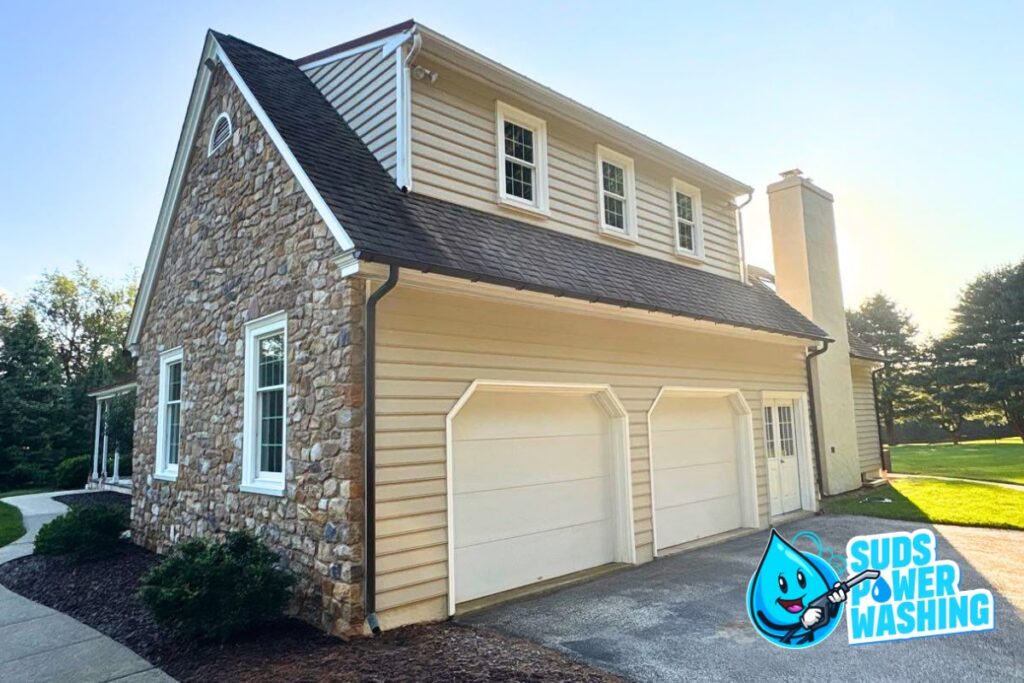
SUDs Power Washing provides professional concrete driveway cleaning in Pennsylvania for residential properties and concrete driveways near me is one of the most searched exterior cleaning queries in the state every spring, from homeowners who spent the winter watching oil spots, tyre marks, and road salt residue accumulate and are now looking for someone to undo all of it before summer. The difference between a concrete driveway that looks clean and one that actually is clean comes down to whether the treatment reached the contamination embedded in the concrete surface, not just what was sitting on top of it.
The oil patch that has been in the same spot since the car started leaking last autumn. The grey-black tyre tracks that appeared after the first snowfall and the salt-and-grit combination that followed. The algae creeped in from the shaded edge near the flower bed. Each of these is a different contamination type that responds to a different treatment, and a single pass with a consumer pressure washer addresses none of them correctly. This article explains what each stain type actually requires, what professional cleaning delivers that DIY equipment cannot, and what a SUDs Power Washing concrete driveway appointment looks like from assessment to final rinse.
In this article:
- Why do concrete driveways stain, discolour, and accumulate contamination and what does each type of stain require to remove?
- What does professional concrete driveway cleaning deliver that DIY pressure washing does not?
- What does a concrete driveway cleaning appointment from SUDs Power Washing involve and is sealing worth adding?
Why do concrete driveways stain, discolour, and accumulate contamination and what does each type of stain require to remove?
Concrete driveways accumulate several distinct contamination types oil and automotive fluid stains that embed in the concrete pores, tyre rubber deposits from acceleration and braking, road salt and de-icer residue from winter, algae and mould growth in shaded or low-drainage areas, and general atmospheric dust and pollen that binds to the surface over time. Each type responds to a different treatment: embedded oil requires chemical degreaser applied before pressure, tyre rubber requires high-temperature pressure treatment, winter salt residue requires alkaline cleaning solution, and algae requires surfactant application and dwell time. A single consumer pressure wash addresses none of these correctly.
Oil stains and automotive fluid: why they go deep and what pulls them out
Concrete is porous; the surface you see is a matrix of microscopic pores that absorb liquid on contact. When motor oil, power steering fluid, or coolant drips onto a concrete driveway, it absorbs into those pores rather than sitting on the surface. A garden hose or even a consumer pressure washer applies water pressure that can displace surface-level oil but cannot reach what has already been absorbed. Commercial-grade degreaser applied before any water pressure, allowed to dwell for 10 to 20 minutes, and then extracted with hot water pressure penetrates the same pores and emulsifies the oil so it can be removed rather than redistributed. This is why the same driveway that looks similar after a consumer pressure wash looks dramatically different after professional degreasing followed by pressure treatment.
Tyre rubber deposits: the black tracking that hose water will not touch
Every time a vehicle turns, accelerates, or brakes sharply on a concrete driveway, it deposits a thin layer of tyre rubber on the surface. Over months and years this builds into the grey-black tracking pattern most homeowners notice along the primary travel path. This contamination bonds to the concrete surface and does not respond to water pressure alone; it requires the combination of a solvent-based pre-treatment and high-temperature pressure application to break the bond and remove the deposit. Most consumer-grade pressure washers do not reach the water temperatures (150 degrees Fahrenheit or above) that make this treatment effective. The rubber is there because traction puts it there, and traction-level chemistry is what removes it.
Winter road salt and de-icer residue: the damage that lasts beyond the season
Pennsylvania roads are treated with road salt and liquid de-icers from November through March. This material tracks onto driveways on tyre surfaces and dries into a white crystalline residue that discolours concrete and over repeated winter seasons contributes to surface scaling and spalling as the salt crystallises in the concrete pores and expands with freeze-thaw cycling. Professional cleaning in spring removes the accumulated salt residue before it progresses to surface damage, using an alkaline cleaning solution that neutralises the acidity of the salt residue more effectively than a plain water rinse.
Algae, mould, and organic staining: the green-black edge creep
Concrete driveways with areas of low sun exposure or poor surface drainage typically near the house edge, along garden bed borders, or under overhanging trees develop algae and mould growth over time. This appears as a grey-green or dark black discolouration spreading inward from the damp perimeter. Algae on concrete creates a slip hazard on wet surfaces and worsens season to season if untreated. Effective treatment requires soft washing surfactant application and dwell time before pressure the surfactant penetrates the algae colony at the root level and the pressure removes it. Pressure alone without surfactant displaces the surface growth without treating the root system, and the algae returns within weeks.
Can concrete driveway stains be removed permanently?
Oil stains that have been absorbed for years may lighten significantly but not disappear entirely from deep pores. Professional degreasing removes accessible contamination and dramatically improves appearance, but a stain that has been soaking for five years is harder to fully remove than one from last autumn. Fresh stains respond better. Winter salt and algae can be fully removed. Tyre deposits can be substantially reduced. Honest framing: professional concrete driveway cleaning will dramatically improve your driveway appearance, and the best results come from regular annual cleaning rather than waiting until the accumulation is severe.
What does professional concrete driveway cleaning deliver that DIY pressure washing does not?
Professional concrete driveway cleaning delivers three capabilities that residential DIY pressure washing cannot replicate: commercial-grade degreaser chemistry applied as a pre-treatment before any pressure, hot water capability (typically 150 to 200 degrees Fahrenheit) that breaks the bond between tyre deposits and concrete surface, and controlled pressure direction and coverage management that protects adjacent garden beds, vehicle finishes, and exterior surfaces from overspray damage. SUDs Power Washing combines all three on every Pennsylvania concrete driveway cleaning appointment.
Commercial degreaser chemistry: what professional products reach that consumer products do not
Consumer driveway cleaning products sold at hardware stores are formulated for surface-level cleaning and light contamination. Commercial-grade degreasers used by professional services have higher active ingredient concentrations, alkalinity levels suited to the specific contamination type, and dwell-activation chemistry that breaks the molecular bond between oil and concrete pore walls rather than simply displacing surface-level grease. The difference in result on driveways with embedded oil from parked vehicles is not subtle. It is the difference between a driveway that looks the same after cleaning and one that looks like a different colour.
Hot water pressure: why temperature matters for tyre deposits and organic staining
Most consumer pressure washers are cold-water units; they deliver water pressure at ambient temperature, typically 40 to 70 degrees Fahrenheit depending on season and supply. Hot water pressure washing units used by professional services heat the water to 150 to 200 degrees Fahrenheit before delivery. The thermal effect on tyre rubber deposits is similar to the effect of hot water on grease in a kitchen; the material softens and releases from the surface at a fraction of the pressure required with cold water. For Pennsylvania driveways with significant tyre tracking, hot water capability is the single most impactful differentiator between a professional result and a consumer DIY result. Family Handyman’s pressure washing guide covers consumer equipment well for basic surface cleaning but the concrete pressure washing guide does not address the hot water requirement that embedded tyre rubber and deep oil actually need.
Surface protection: what professional crews manage that consumer rigs frequently damage
A homeowner using a consumer pressure washer on their concrete driveway is managing a live water pressure stream that, if misdirected, can strip paint from adjacent surfaces, damage vehicle finishes, blast soil and mulch from garden beds, and force water under door weather seals. Professional crews manage pressure direction, nozzle selection, and coverage pattern to clean the target surface without damaging adjacent surfaces. They also use rinse containment technique to prevent dirty runoff from washing into storm drains which is a concern in many Pennsylvania municipalities. The job on the target surface is not the only job happening during a professional power washing appointment.
How much does professional concrete driveway cleaning cost in Pennsylvania?
Professional concrete driveway cleaning in Pennsylvania in 2026 typically costs $100 to $250 for a standard single-family residential driveway, with the range driven by driveway size (square footage), contamination severity, and whether degreaser pre-treatment is required for embedded oil. Driveways with heavy oil staining or large surface area typically sit toward the higher end. SUDs Power Washing provides written estimates for driveways concrete cleaning before any appointment is scheduled the price confirmed before the crew arrives is the price on the invoice when they leave.
What does a concrete driveway cleaning appointment from SUDs Power Washing involve and is sealing worth adding?
A SUDs Power Washing concrete driveway cleaning appointment in Pennsylvania begins with contamination assessment and pre-treatment application degreaser for oil zones, surfactant for algae zones, alkaline solution for salt-affected areas followed by hot water pressure washing of the full driveway surface, targeted treatment of any remaining heavy staining, and a final rinse that removes all cleaning product residue and treated contamination. The appointment typically takes 60 to 120 minutes for a standard residential driveway and leaves the surface clean to the concrete colour rather than just lighter than it was before.
Before the crew arrives: move vehicles off the driveway, clear any loose items from the surface, and note any specific areas of heavy staining so the crew can prioritise pre-treatment zones. During the appointment: the crew works by contamination zone, not by a uniform single-pass approach oil treatment goes to the parking area, algae treatment goes to the shaded edge, salt treatment to the areas near the road. Dwell time is built into the sequence. Hot water pressure then extracts what the chemistry loosened. A final clean water rinse removes everything from the surface and leaves the concrete at its actual colour, not its year-of-grime colour.
Walkway cleaning is often added to the same appointment for homeowners doing a complete hardscape refresh. Patio cleaning rounds out the full outdoor surface cleaning that most Pennsylvania homeowners need at the start of spring.
Is concrete driveway sealing worth it after professional cleaning?
Yes, and the best time to seal a concrete driveway is immediately after professional cleaning, because the concrete is clean and the pores are open for maximum sealer penetration. Concrete sealers reduce future oil and fluid absorption (making future stains easier to remove on the next cleaning), reduce winter salt penetration that contributes to surface scaling, and restore the concrete to a uniform appearance that holds between annual cleanings. Not every driveway needs sealing every year a well-sealed driveway in Pennsylvania conditions typically needs re-sealing every two to three years. Sealing is particularly worth considering for driveways with a history of oil staining or visible winter surface damage. SUDs Power Washing can advise on sealing suitability at the time of the concrete driveway cleaning appointment — no separate call needed.
Your Concrete Driveway Should Look Like Concrete, Not Like a Year of Accumulated Everything
You know what caused each stain. You know why the hose did not fix it. You know what hot water degreaser chemistry does that a consumer rinses cannot. The driveway has been on the list long enough.
Book a concrete driveway cleaning with SUDs Power Washing and find out what the actual colour of your concrete is.