
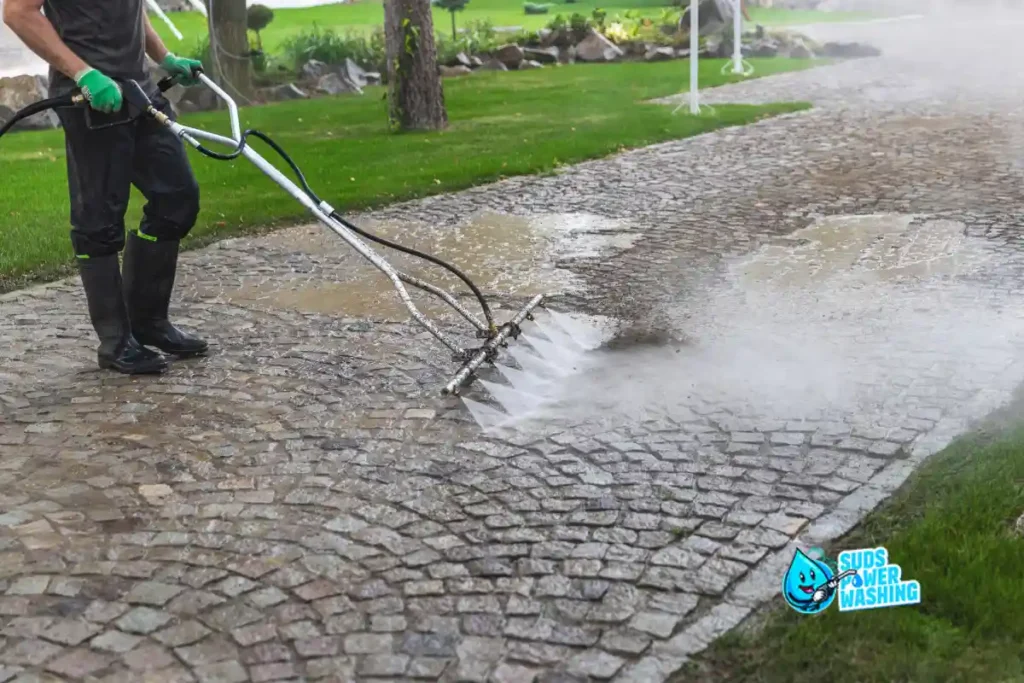
SUDs Power Washing provides power washing services across Pennsylvania, covering driveways, siding, decking, patios, walkways, and commercial surfaces for homeowners and property managers who want a clean exterior without the equipment rental and the following Saturday they wish they had back. The videos make it look effortless. A grimy driveway goes from green-black to almost white in one slow pass and it is genuinely impressive to watch. What those clips do not show is the surface preparation, the pressure calibration, the time, or the very specific ways that doing it at the wrong settings on the wrong material goes wrong.
If you have ever watched one of those clips and wondered whether your own driveway, siding, or deck could look like that, the answer is probably yes. Whether you should be the one doing it is a different question. This guide covers what power washing actually is, what it realistically costs, and what a professional service visit looks like once you decide to book one.
In this article:
What does power washing actually clean and how is it different from pressure washing?
Power washing uses a high-pressure stream of heated water to remove dirt, grime, mold, algae, and biological buildup from outdoor surfaces including concrete, siding, decking, and walkways. The heat is the part that separates it from cold-water pressure washing, since it helps break down grease and stubborn organic growth that cold water alone has difficulty shifting.
Most people have used both terms and been understood either way, which is fine in everyday conversation. The distinction starts to matter when a contractor is deciding which method is actually right for a specific surface on a specific property.
What is power washing exactly?
Power washing uses a high-pressure stream of heated water to remove grime, mold, algae, and biological growth from outdoor surfaces. The heat distinguishes it from pressure washing, which uses cold water at high pressure, and it is particularly effective on surfaces with oil staining, heavy organic growth, or buildup that has accumulated over multiple seasons.
For most homeowners, power washing is the term that comes to mind first because it is the one that shows up in the videos. In practice, what matters more than the label is whether the water temperature and pressure being used are appropriate for the surface you are cleaning. Concrete can handle high heat and high pressure without damage. Certain types of siding, older painted wood, and composite decking cannot, and applying the wrong approach to those materials is where the satisfying-online version of this job turns into an expensive repair.
Is power washing the same as pressure washing?
Not exactly, though using the terms interchangeably in conversation rarely causes any practical confusion. The actual difference is water temperature. Power washing uses heated water; pressure washing works with cold water at high pressure. Many professional companies use both methods depending on the job and the surface, adjusting the approach to what the material can safely handle rather than defaulting to a single setting for everything.
If you have been searching one term and finding companies that advertise the other, you have probably not made a mistake. What is worth asking about is whether the company adjusts their technique by surface type, since that is the question that actually affects your specific result.
What areas of a property get power washed most often?
Driveways, concrete walkways, and patios are the most common starting point because concrete is forgiving and the visual difference is dramatic. After that, siding, decking, fences, and roofing surfaces all come up regularly, though each requires a different approach depending on the material. The right service category depends on whether the property is a home or a business, since the scope, scheduling, and surface mix are different in each case.
Our residential power washing page covers what is typically included for a home, and our commercial power washing page covers what changes for a business property. For driveways specifically, the driveway and concrete cleaning page walks through what the process usually looks like and what kinds of staining it addresses.
Is power washing worth hiring a pro for or can you do it yourself?
Hiring a professional power washing service in Pennsylvania is worth it for most homeowners when the surfaces involved are anything other than straightforward concrete, when the property has multiple surface types that need different approaches, or when the time and equipment cost of a DIY attempt does not clearly justify the savings.
This is one of those decisions where the viral video does some damage. A fifteen-second clip of a driveway getting cleaned does not show the surface assessment, the equipment calibration, the protection of surrounding plants and materials, or the cleanup afterward. None of that is impossible for a careful DIY attempt, but it is also not nothing.
How much does power washing typically cost?
Cost for a professional power washing service depends on the surface type, the total area being cleaned, and how much buildup has accumulated. A straightforward driveway is a different job from a full exterior siding cleaning, which involves more time, different equipment settings, and more careful technique around windows, trim, and any painted surfaces.
Rather than quoting a flat number that may not match your specific property, most professional companies provide a quote based on an actual look at the job. Our power washing services page is the starting point for finding out what applies to your specific surfaces and getting a number that is actually accurate.
What are the actual risks of DIY power washing?
Renting equipment and doing it yourself is a reasonable option for some jobs, and plenty of people do it successfully on concrete surfaces with straightforward buildup. The risks that come up are usually one of two things: too much pressure on a surface that cannot handle it, which strips paint, cracks older siding, or raises wood grain in a way that cannot be reversed without sanding and refinishing; or a handling injury from the equipment itself.
Pressure washers can cause deep lacerations if the nozzle contacts skin, which is why the US Consumer Product Safety Commission publishes specific safety guidance on using this equipment correctly. This is not a reason to avoid DIY entirely. It is a reason to approach it with a clear understanding of what your specific surfaces can handle and what the equipment is actually capable of, rather than with the confidence that comes from watching someone else do it in a clip that is edited for entertainment rather than instruction.
How do you find a trustworthy power washing company near you?
The useful signals are straightforward: the company carries liability insurance, communicates specifically about what is included before any work starts rather than after it is done, has real reviews from verifiable customers, and asks questions about your specific property rather than quoting a flat rate without seeing it.
A company that wants to know your surface type, the size of the area, and what kind of staining you are dealing with before they name a price is generally one that knows what they are doing. A company that quotes the same number for every job without any of those questions is one worth being cautious about.
What does booking a power washing service actually involve?
A professional power washing visit moves from a brief assessment of the surfaces and their condition, through cleaning matched to what those surfaces can handle, to a thorough rinse and cleanup before the crew leaves. Most residential jobs run a few hours depending on property size and how many surfaces are included.
Knowing the general shape of the visit makes it easier to plan around, particularly if the job involves a driveway or walkway that needs to stay clear during the work.
What happens during a professional power washing visit?
The crew starts with a look at the surfaces rather than immediately setting up equipment and starting. That assessment determines the right pressure level and method for each area, since concrete and siding respond differently and need to be treated differently even within the same visit. After cleaning, a thorough rinse removes any residue or loosened buildup so it is not just redistributed across the surface. A good crew cleans up before leaving, including any runoff directed away from gardens or landscaping during the job.
How often should you book power washing?
Most properties in Pennsylvania benefit from professional cleaning about once per year. Properties with significant shade, nearby trees dropping organic matter, or high humidity will see buildup accumulate faster and may need attention more frequently. Surfaces that tend to retain moisture, like north-facing walls or areas under tree canopy, also tend to develop algae and mold growth more quickly than exposed surfaces that dry fully after rain.
For surfaces that need regular maintenance but are more delicate than standard concrete or brick, soft washing services use a lower-pressure approach that is gentler on the material while still addressing biological growth effectively. A simple annual check in spring, looking at surfaces the way you would look at them as a first-time visitor, is usually enough to tell you whether it has been long enough.
What should you ask before hiring a power washing company?
Three questions cover most of what matters. Ask whether they carry liability insurance and whether the crew doing the job is covered under it, since the answer is worth knowing before anyone is on your property. Ask whether they have experience with your specific surface type, since concrete experience does not automatically translate to siding or deck experience, and a straightforward answer is a good sign. Ask for a pricing breakdown that separates what is included from what would cost extra rather than a single total that is hard to evaluate.
A fourth worth adding: ask how they handle nearby plants and landscaping during the job. Runoff from cleaning solutions can affect vegetation if it is not directed or neutralised, and a company that has thought about this is one that is paying attention to the full result, not just the surface being cleaned.
When the right company and the right scope are in place, the result actually is as satisfying as the video. Just with more context behind it. To get started, get a power washing quote from SUDs and find out what your specific property needs.
The real version of power washing is more considered than a short clip. The surfaces need the right approach, the scheduling needs a couple of hours, and the results hold up longer when the prep and cleanup are done correctly. The satisfying part, an exterior that actually looks different, is real. It just takes a little more behind it than the video makes it look.
SUDs Power Washing provides power washing services across Pennsylvania. When you are ready to find out what your property actually needs, get a power washing quote and go from there.